
Quality You Can Measure: Testing and Verifying the Ultrasonic Bonding Process
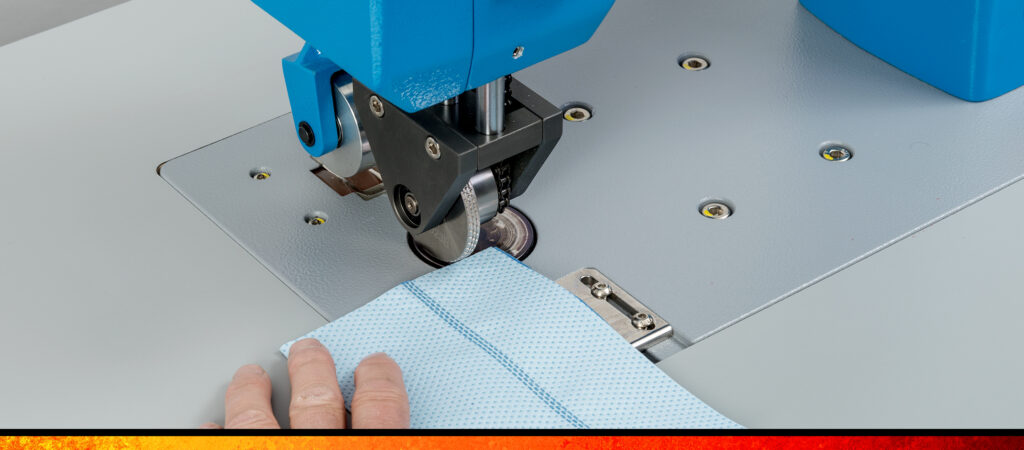
Manufacturers need confidence that every ultrasonic bond, whether it be a seam, splice or welded connection, will meet the mechanical, electrical, dimensional or barrier requirements of the finished product. That confidence begins with a controlled ultrasonic bonding process and continues through application testing, sample evaluation, operator training and ongoing process verification.
Because materials, geometry of the part and performance requirements vary, no single test can confirm every ultrasonic bond. The most effective quality program combines process monitoring with physical testing that reflects real-world performance.
What Is Ultrasonic Bonding?
Unlike joining methods that depend on adhesives, thread, solder or extensive external heat, ultrasonic technology uses high-frequency mechanical vibrations and applied pressure to create a localized bond. For synthetic textiles, the vibrations soften and fuse thermoplastic fibers. In metal welding, they disrupt oxides and surface films, so the materials form a solid-state metallurgical bond.
Start With a Clearly Defined Bond Requirement
Before selecting equipment or setting operating parameters, manufacturers should determine what the bond must accomplish.
A metal connection may need to:
- Withstand a specified pull force
- Maintain low electrical resistance
- Meet dimensional tolerances
- Resist vibration, corrosion or thermal cycling
- Avoid damage to thin foils, wires or surrounding components
A nonwovens textile seam may need to:
- Resist peeling or separation
- Prevent air or liquid leakage
- Maintain a moisture barrier
- Withstand repeated flexing
- Preserve the appearance and integrity of the material
These requirements establish measurable acceptance criteria. Rather than describing a bond as simply “strong” or “good,” the manufacturer can define an acceptable force, resistance, dimension, leak rate or failure mode.
The intended materials are equally important. Sonobond’s ultrasonic metal welding systems can join a range of nonferrous metals, including copper, aluminum, nickel alloys, precious metals and many dissimilar combinations.
Ultrasonic textile bonding generally works with synthetic or blended materials that contain enough thermoplastic content to soften and fuse under ultrasonic energy.
Use Sample Welds to Prove the Application
One of the most effective ways to evaluate the ultrasonic bonding process is to produce sample welds using the actual production materials.
Sonobond offers free, no-obligation sample testing using customer-supplied materials to determine whether ultrasonic bonding is suitable. The evaluation helps identify the appropriate machine and establish preliminary process parameters.
Testing the real components is important because small differences can affect the finished bond, including:
- Material composition and coating
- Wire strand count
- Surface oxidation or plating
- Fabric weight and synthetic content
- Number and orientation of layers
- Part thickness
- Joint geometry
- Tool access
- Required bond width or pattern
During an application evaluation, the manufacturer and equipment supplier can establish an initial process window by adjusting variables such as weld time, energy, pressure, amplitude, height or material feed rate. Sample parts can then be examined against the customer’s performance requirements.
Select Testing Methods That Match the Application
Physical testing should simulate the stresses the bond will encounter in service. Depending on the product, manufacturers may use destructive testing, nondestructive inspection or a combination of both.
Pull and Tensile Testing
Pull testing is commonly used for wire splices, wire-to-terminal welds and other metal assemblies. A test machine applies a controlled load until the bond reaches a specified force or fails.
The maximum force is important, but the location and type of failure can provide additional information. For example, a wire that breaks outside the weld zone may indicate that the bond is stronger than the surrounding material. Separation directly at the interface may indicate that process parameters, part positioning or surface conditions need further evaluation.
Textile manufacturers may also use tensile or seam-strength testing to measure how much force a bonded seam can withstand. ASTM maintains textile standards covering the physical and mechanical properties of fabrics and fibers, while ASTM D751 provides test methods for coated fabrics used in products where seam strength, adhesion or barrier performance may be important.
Peel Testing
Peel testing applies force at an angle to determine how readily two bonded layers separate. The test may record the peak force, average force or failure pattern. Consistent peel behavior across multiple samples can help confirm that the bond is forming evenly across the intended area.
It can be useful for:
- Laminated textiles
- Coated fabrics
- Overlapping seams
- Thin metal sheets
- Foil-to-tab assemblies
Electrical Resistance Testing
For electrical assemblies, mechanical strength alone is not enough. A wire splice, terminal connection, bus bar or battery tab must also conduct current efficiently.
Resistance measurement can verify the electrical performance of the joint. A stable, low-resistance reading helps indicate that adequate metal-to-metal contact has been established throughout the bond.
Ultrasonic metal welding creates a solid-state metallurgical bond without melting the surrounding metals. Mechanical vibration and pressure disrupts surface oxides, producing a bond with excellent electrical conductivity.
Leak, Burst and Barrier Testing
For filters, medical products, dry bags, protective equipment and other sealed textile assemblies, bond integrity may be defined by the ability to prevent air, water or contaminants from passing through the seam.
Depending on the product, verification may include:
- Air-pressure decay testing
- Water-submersion testing
- Hydrostatic pressure testing
- Bubble leak testing
- Burst testing
- Dye-penetration testing
These methods help identify leaks, incomplete bond areas or damage that may not be visible during routine inspection.
The ultrasonic bonding process for performance textiles creates seams without needle holes, thread or adhesive gaps. It can also bond and trim in one operation, producing sealed edges that resist fraying and unraveling.
Visual and Dimensional Inspection
Visual inspection remains useful when it is based on documented criteria. Dimensional checks can confirm bond width, compression height, part position or other critical measurements. Visual inspection should not replace mechanical or functional testing, but it can identify obvious process changes before more parts are produced.
Operators may check for:
- Correct bond location
- Uniform seam width
- Complete pattern transfer
- Wrinkling or material distortion
- Cut or damaged wires
- Excessive indentation
- Misaligned layers
- Frayed or unsealed edges
Monitor the Process, Not Just the Finished Part
Finished-part testing confirms the result. Process monitoring explains how that result was achieved.
Advanced ultrasonic metal welding controls can operate by time, energy, height or height with energy. Sonobond’s advanced human-machine interface displays pressure and power graphs, stores weld records and exports data for analysis. Weld-result feedback also helps operators identify deviations from established process settings.
Depending on the system, useful process information may include:
- Weld time
- Energy delivered
- Power profile
- Pre-weld and post-weld height
- Pressure
- Cycle completion status
- Alarm history
- Weld count
Once an acceptable process window has been established, these values can be monitored for meaningful changes. A sudden shift in energy, height or power may point to an incorrectly loaded part, material variation, worn tooling or another condition that requires attention. Stored protocols also reduce the risk of relying on operator memory when changing between products.
Turn Successful Trials Into Repeatable Production
A successful laboratory sample is only the first step. The ultrasonic bonding process must remain stable during full-scale production despite operator changes, shift schedules and normal material variation.
A documented setup should identify
- Approved materials and part numbers
- Tooling and fixture requirements
- Machine settings
- Loading and alignment instructions
- Inspection frequency
- Test methods
- Acceptance limits
- Procedures for responding to a failed test
Operators should understand how to load parts consistently, identify an acceptable bond and recognize early signs of process drift.
Sonobond systems are designed for straightforward operation and efficient operator training. The company also provides technical support before, during and after installation to help customers incorporate the equipment into their production process.
Hands-on training can cover tooling changes, parameter selection, routine inspections, preventive maintenance and troubleshooting. This knowledge helps production teams distinguish between a machine-related issue and a variation caused by the material, part placement or application setup.
Use On-Site Consultation for Final Process Validation
Some applications cannot be fully qualified in a remote laboratory. Complex automation, existing production lines, unusual part-handling requirements or facility-specific quality procedures may require support at the customer’s plant.
On-site consultation gives the equipment supplier an opportunity to observe actual production conditions, confirm the installation and help refine the process with the customer’s operators and quality personnel.
This final review may include:
- Confirming machine and tooling setup
- Running production materials
- Reviewing sample test results
- Establishing approved parameter ranges
- Training operators and maintenance personnel
- Observing loading and unloading procedures
- Addressing variation between shifts or material lots
- Documenting the final process
Build Quality Into Every Bond
A reliable ultrasonic bonding process depends on more than machine settings. It requires matching the equipment and tooling to the application, validating the process with production materials, monitoring process variables and training operators to produce consistant results.
Together, sample testing, process monitoring, physical verification, operator training and on-site support help manufacturers move from successful prototypes to repeatable production with greater confidence.
Verify Your Application With Sonobond
Sonobond can evaluate your application, produce sample welds using your materials, and recommend the equipment, tooling, and process parameters best suited to your production requirements.
Request free sample welds or contact Sonobond Ultrasonics to discuss your bonding requirements with an applications specialist.
Frequently Asked Questions
1. How is an ultrasonic bond quality tested?
The appropriate method depends on the application. Common techniques include pull, tensile, peel, burst, leak and electrical resistance testing. Manufacturers should select a test that represents the mechanical, electrical or barrier stresses the finished product will encounter.
2. What factors affect the ultrasonic bonding process?
Bond quality can be influenced by material composition, thickness, coatings, oxidation, layer count, part geometry, tooling, alignment, pressure, energy, weld time and operator loading. Testing with actual production materials helps identify an acceptable process window.
3. Can ultrasonic bond quality be monitored during production?
Yes. Depending on the equipment, manufacturers can monitor values such as weld time, energy, power, pressure and height. Stored weld protocols, alarms and production records can help identify deviations before they lead to a larger number of rejected parts.
4. Why are sample welds important before purchasing ultrasonic equipment?
Sample welds allow manufacturers to determine whether their materials can be joined ultrasonically and whether the completed bond meets their specifications. They can also help identify the appropriate machine, tooling and operating parameters before the equipment is placed into production.
5. Does Sonobond provide training and on-site technical support?
Sonobond provides customer service and technical support before, during and after installation. Support can include application evaluation, process setup, operator training and on-site assistance with final production approval.
6. What industries use the ultrasonic bonding process?
The ultrasonic bonding process is widely used in medical device manufacturing, automotive wiring, electronics, battery production, aerospace, filtration, packaging, nonwoven textiles, protective apparel, and industrial assembly applications because it produces strong, repeatable bonds without adhesives or excessive heat.