
Building Strong Connections: Why Ultrasonic Welding is Redefining Reliability in Manufacturing
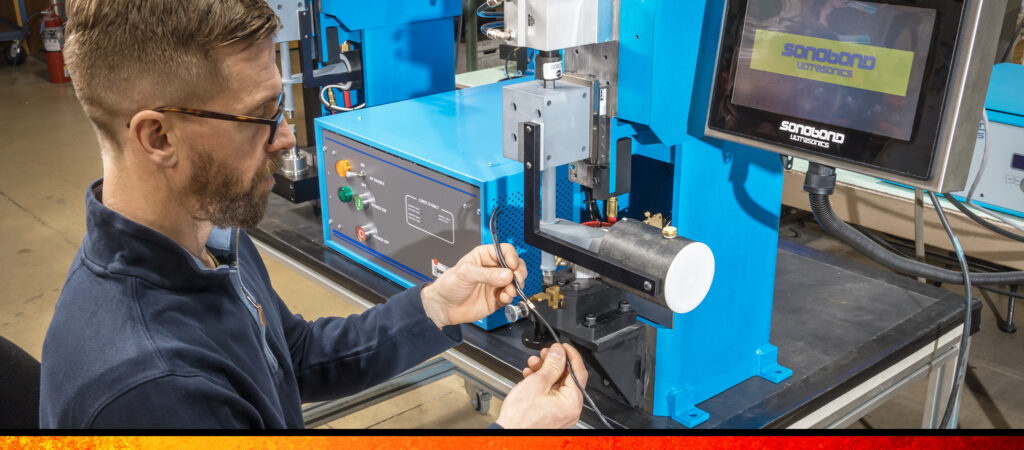
We’re excited to introduce our new blog, Sound Thinking. Here we’ll share our expertise, the latest developments in ultrasonic technology and real-world examples from different industries. Our first post looks at how an ultrasonic welding system can help deliver quality and reliability across a wide range of products and markets.
Today’s manufacturers demand greater precision, reliability and sustainability to stay competitive and meet evolving industry standards. Ultrasonic welding systems have emerged as a key technology for achieving these goals. This advanced joining process is increasingly replacing traditional methods such as soldering and adhesives to create stronger, safer, more reliable connections in modern, high-volume manufacturing.
What is Ultrasonic Welding?
An ultrasonic welding system uses high-frequency mechanical vibrations and pressure to bond plastics and metals quickly and efficiently, often completing the process in just seconds. Unlike traditional methods, these systems do not require heat, adhesives or mechanical fasteners, making them a clean, safe and efficient option. The process produces strong and precise bonds, consumes less energy, and has minimal environmental impact.
Because ultrasonic welding generates very little heat during operation, it is ideal for temperature-sensitive materials, delicate components that could be damaged by heat and materials prone to oxidation at high temperatures. The process also helps prevent burns and injuries from hot machine parts, making workplaces safer and more reliable.
The Importance of Weld Reliability
Almost all manufactured products rely on joints or bonds to function effectively. For example, auto components such as dashboard assemblies, body panels and electrical wiring depend on strong, reliable joints.
The quality of these joints directly affects how well a product performs. Weak or inconsistent bonds can cause structural failures, shorten product life, and create safety issues, especially in industries like automotive, aerospace and electronics. Strong joints, on the other hand, ensure products last longer, perform consistently, reduce rework and meet stringent industry standards. Whether in assembly or equipment fabrication, high-quality welds are essential for producing durable, dependable products.
Ultrasonic welding systems address many challenges associated with traditional welding methods, including heat distortion, weak joints and contamination. They provide accurate, repeatable and consistent performance to ensure high-quality bonds and support reliable, high-volume manufacturing.
With weld cycles lasting between 0.5 to 2 seconds, ultrasonic welding enables rapid production with minimal bottlenecks. The reliability of this process ensures that every part meets design specifications and product standards, reducing defects and improving overall product performance in the field.
Sustainability and Efficiency Advantages
Ultrasonic welding offers both sustainability and efficiency benefits that directly support reliable manufacturing. Its energy-efficient, clean process promotes environmental responsibility while maintaining consistent weld quality that reduces defects and rework.
Sustainability Advantages
- Low energy consumption: An ultrasonic welding system uses high-frequency mechanical vibrations instead of heat, consuming only about 5% of the energy used in resistance welding and about 20% energy needed for a riveted panel.
- Energy efficient: Requires no adhesives, solvents, solder or flux, reducing chemical waste and environmental impact. The process also eliminates the need for special ventilation or cleaning.
- Minimal material waste: Precision welding produces very little scrap or rework and requires no consumable materials such as clips, solder or flux.
- Reduced emissions and contaminants: An ultrasonic welding system produces no smoke, fumes, emissions or residues, producing a cleaner, safer and more environmentally friendly working environment.
- Longer product lifespan: Stronger welds improves durability, reducing the need for repairs or replacements and lowering energy and material use over time.
Efficiency Advantages
- Fast cycle times: Ultrasonic welding is extremely fast. Depending on the application, connections can be made in less than a second, supporting high-speed production. Unlike other joining methods, it requires no warm-up or cool-down time.
- Enhanced quality: The process produces strong, durable, vibration-resistant joints that improve product longevity and reduce downtime.
- High repeatability and reliability: Consistent bonds reduce rework, rejects and maintenance costs. Automated ultrasonic welding systems also reduce operational and human error.
- Bonds dissimilar materials: Ultrasonic welding can join metals, plastics and hybrid assemblies without additional processing or adhesives, offering versatility that many other welding methods cannot.
Diverse Industry Applications
Ultrasonic welding is recognized as one of the fastest and most efficient methods to join metals, across industries. According to Custom Market Insights, the market continues to grow due to increasing demand in the automotive and electronics sectors.
The largest market segment is the automotive industry. Beyond joining components like instrument panels and steering wheels, growth is driven by the rise of electric vehicles (EVs). EV production increasingly depends on ultrasonic welding for battery assemblies and wire harnesses. With EV sales projected to double by 2030, demand for heat-free welding of batteries, wiring, and components will continue to increase, It’s a challenge that ultrasonic welding is uniquely equipped to meet.
The electronics sector ranks as the second-largest market, driven by the need for precise, delicate assemblies such as printed circuit boards, where clean, precise bonds are critical for performance.
Innovation at Sonobond
Sonobond Ultrasonics has been at the forefront of ultrasonic welding technology since inventing the process in 1960. With over 150 patents, the company continues to advance the field through innovative solutions that enhance manufacturing reliability, efficiency and product quality. One of its notable innovations is the Wedge-Reed Ultrasonic Welding System, recognized as one of most efficient methods for creating safe, consistent ultrasonic welds.
In October 2022, Sonobond joined the Inductotherm Group, gaining access to advanced power supply technologies, global service resources, and expanded supply chain capabilities. This integration enables Sonobond to provide more cost-effective assembly solutions and support a broader range of applications.
Through continuous innovations and expanded resources, Sonobond Ultrasonics remains a leader in ultrasonic welding systems, providing efficient, reliable and environmentally friendly joining solutions.
For more information on Sonobond’s ultrasonic technology and equipment, or to submit materials for a free Ultrasonic Welding Viability Test, visit www.SonobondUltrasonics.com.
Watch our capabilities video to see how our innovative ultrasonic solutions can improve your processes and performance.
FAQs
1. Why is ultrasonic welding so reliable?
It creates clean, consistent bonds without using heat, glue or fasteners. That means fewer defects, stronger joints, and better product performance every time.
2. Where is ultrasonic welding used?
You’ll find it everywhere, from cars and electronics to medical devices and packaging. Any industry that wants to create bonds with precision, speed and safety can benefit from it.
3. How is it better for the environment?
Ultrasonic welding uses very little energy, produces no smoke or fumes and eliminates the need for chemicals or adhesives, making it a greener, cleaner process.
4. Can it join different kinds of materials?
Absolutely. Ultrasonic systems can bond metals, plastics, and even mixed materials without extra prep or adhesives, making them incredibly versatile.
5. What sets Sonobond apart in this field?
Sonobond has been leading the way in ultrasonic technology since 1960. Its innovative systems, like the Wedge-Reed design, help manufacturers make stronger, more reliable products efficiently and sustainably.
Frequently Asked Questions about SonoBond for Textiles
Sed ut perspiciatis unde omnis iste natus error sit voluptatem accusantium doloremque laudantium, totam rem aperiam eaque ipsa quae ab illo inventore veritatis.
Download Now