
Welding Electronics Components: How Ultrasonic Technology Creates Reliable Connections
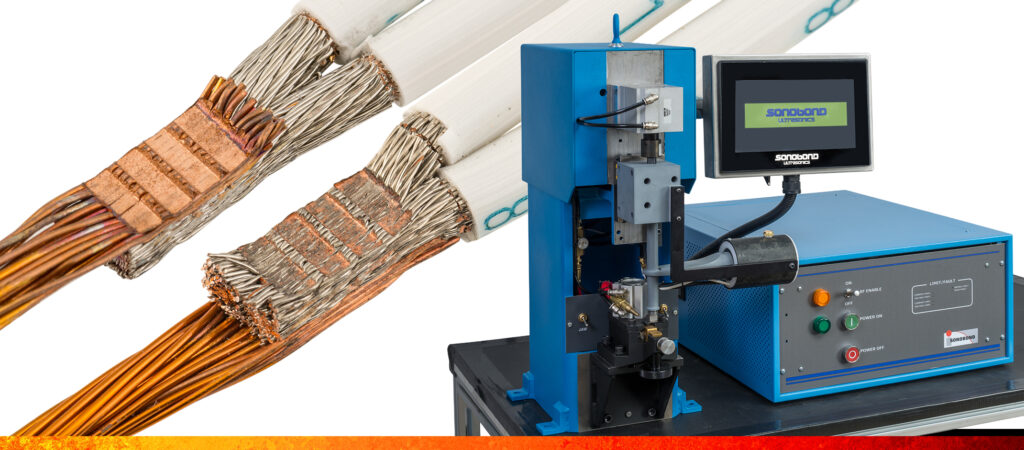
When welding electronics components, even the smallest connection can have a major impact on the performance and reliability of the finished product. Wire splices, terminals and electrical contacts must carry current consistently while withstanding vibration, temperature changes, moisture and mechanical stress. If a connection loosens, corrodes or develops excessive electrical resistance, the entire system can become less efficient or fail.
Ultrasonic metal welding creates strong, conductive electrical connections without melting the base metals or requiring additional materials. The process is particularly well suited for stranded wires, terminals, bus bars and other nonferrous metal components.
Why Electrical Connections Demand More Than Mechanical Contact
Electrical assemblies depend on connections that provide both mechanical strength and consistent conductivity. A joint may appear secure while still containing gaps, contamination or unstable contact points that increase resistance.
These weaknesses become more significant when assemblies operate in demanding environments. Wire harnesses used in vehicles, industrial equipment, appliances, aerospace systems and electronic devices may experience repeated vibration, shock and wide temperature swings. Over time, a poorly formed connection can loosen or deteriorate.
Industry standards reflect the importance of connection integrity. For example, SAE USCAR-38 establishes performance criteria and testing methods for ultrasonically welded wire-to-terminal bonds used in automotive applications. Its evaluations include environmental and mechanical exposures intended to simulate long-term field conditions. The IEC 60352-9:2024 standard also provides requirements, testing procedures and practical guidance for ultrasonically welded electrical connections.
These standards reinforce the fundamental point that a successful electrical joint must remain mechanically stable and electrically efficient throughout its service life.
Why Use Ultrasonic Welding for Electronics?
Ultrasonic welding is well suited for electronics and electrical assemblies because it creates low-resistance metallurgical bonds while limiting heat transfer to surrounding components. Unlike soldering, it does not require solder or other consumables, and unlike conventional fusion welding, it does not melt the base metals. Key advantages include:
- Low electrical resistance
- Strong mechanical bonds
- Minimal heat transfer
- No solder, flux, or filler materials
- Ability to join many similar and dissimilar nonferrous metals
How Ultrasonic Metal Welding Works
Ultrasonic metal welding is a solid-state joining process, which means the materials do not need to reach their melting temperatures. Instead, the system applies controlled pressure and high-frequency mechanical vibration parallel to the weld interface.
The vibration creates localized movement between the metal surfaces. This action disperses surface oxides and contaminants while bringing clean metal surfaces into close contact. Under pressure, the materials form a solid-state metallurgical bond.
Because the metals do not undergo bulk melting, ultrasonic welding avoids many of the challenges associated with fusion-based joining processes. It does not require solder, brazing alloys or other added materials. The process also limits heat transfer, which is valuable when welding electronics components near insulation, films or heat-sensitive materials.
Research has identified ultrasonic metal welding as an effective joining method for welding electronics and electrical components because it produces connections with strong mechanical and electrical properties. A review published in the Journal of Manufacturing Processes, for example, describes the process as particularly advantageous for connecting the electrical systems and wire harnesses used in new-energy vehicles.
Ultrasonic Wire-to-Wire Splicing for Electronics
Wire splicing is one of the most common applications for ultrasonic metal welding. Multiple strands or conductors can be consolidated into a compact, solid connection without crimp sleeves, solder or consumable connectors.
During the weld cycle, ultrasonic energy helps remove surface films and joins the individual strands together. The resulting splice behaves as a unified conductive section rather than a bundle held together only by mechanical compression. Ultrasonic welding offers several advantages:
- Low electrical resistance
- High pull strength
- Compact splice dimensions
- Consistent strand consolidation
- Resistance to vibration and mechanical stress
- Fast production cycles without curing or cooling periods
For production environments that handle frequent wire-splicing operations, Sonobond’s SpliceRite® Ultrasonic Wire Splicer is designed to produce consistent wire-to-wire bonds quickly. The system can join similar or dissimilar nonferrous metals and accommodate multiple conductors in one weld height or material feed rate. Sample parts can then be examined against the customer’s performance requirements.
Creating Reliable Wire-to-Terminal Connections
Wire-to-terminal welding is another critical electrical assembly application. Rather than relying solely on mechanical deformation to hold a conductor against a terminal, ultrasonic welding forms a metallurgical bond between the wire strands and the terminal surface.
A properly developed wire-to-terminal weld provides a stable conductive path that can withstand vibration, thermal cycling and mechanical loading. This makes the process valuable when manufacturing components for transportation, power distribution, industrial controls and other systems in which long-term electrical reliability is essential.
Sonobond’s SonoWeld® ultrasonic metal spot welder performs wire-to-terminal, wire-to-wire and spot welds. Its microprocessor control can store and recall weld protocols, helping manufacturers apply repeatable process settings across production runs.
For heavier-gauge wires, terminals and electrical assemblies, the WeldMAX® ultrasonic spot welder provides higher power for applications such as heavy-gauge wire connections, bus bar fabrication and other high-current assemblies.
Welding Copper, Aluminum and Other Dissimilar Metals
Electrical assemblies increasingly combine different conductive materials. Copper offers excellent conductivity, while aluminum can reduce weight and material costs. However, joining copper and aluminum with processes that rely on melting can be difficult because the metals have different thermal and metallurgical properties.
Ultrasonic welding can join many similar and dissimilar nonferrous metals in the solid state. Depending on the application and equipment configuration, combinations may include copper-to-copper, aluminum-to-aluminum and copper-to-aluminum assemblies.
Surface condition also matters. Oxides, coatings and contamination can interfere with bonding if the welding system cannot adequately disrupt the surface layers. Sonobond’s unique Wedge-Reed System applies shear-mode vibration parallel to the weld surface, helping remove oxides and create direct metal-to-metal contact.
Ultrasonic metal welding systems can join certain oxidized and tinned metals without requiring precleaning or removal of the tin coating. This capability can reduce preparation steps when working with tinned wires commonly used to improve corrosion resistance and solderability.
Supporting Repeatable Production Quality
Achieving consistent results when welding electronics components requires precise process control. Welding energy, amplitude, pressure, time and final weld dimensions must be matched to the materials and joint geometry.
Too little energy may leave strands insufficiently bonded. Excessive energy or pressure can deform the conductors, damage individual strands or reduce the material thickness more than intended. Tooling condition, part placement and material consistency also affect the result.
Modern ultrasonic welding systems help manufacturers manage these variables by storing validated weld protocols and monitoring parameters during each cycle. Operators can recall established settings when changing assemblies, reducing dependence on manual adjustments.
The SonoWeld system, for example, can store more than 250 weld protocols and operate using time-, energy- or distance-based modes. This type of control supports consistent results across repeated production runs.
Quality assurance programs may also include:
- Visual inspection of weld shape and strand consolidation
- Pull or peel testing
- Weld-height measurement
- Electrical resistance testing
- Cross-section or metallographic analysis
- Periodic tooling inspection
- Process data review and documentation
When Ultrasonic Welding Is the Right Choice
Soldering and crimping remain useful assembly methods, but they are not ideal for every connection. Solder requires heat and added material, while crimping depends on maintaining sufficient mechanical compression between the conductor and connector.
Ultrasonic welding is often the stronger option when the assembly requires a compact metallurgical bond, low electrical resistance, high vibration resistance or the joining of multiple stranded conductors. It can also simplify production by eliminating additional consumables.
As electrical systems become more powerful, compact, and complex, reliable wire and terminal connections become increasingly important. Ultrasonic technology provides the speed, process control, and bond quality needed for welding electronics components in demanding applications.
From wire-to-wire splices and wire-to-terminal connections to bus bars and high-current assemblies, ultrasonic metal welding creates strong, conductive bonds designed for long-term service..
Improve Your Electrical Assemblies
Not sure which ultrasonic welding system is right for your electronics application? Sonobond Ultrasonics can evaluate your wire, terminal, and electrical component samples to recommend the appropriate welding system, tooling, and process parameters. Contact Sonobond to discuss your electrical assembly requirements or request a sample weld evaluation.
Frequently Asked Questions about Welding Electronics
1. How does ultrasonic welding work for electronics?
Ultrasonic welding for electronics is a solid-state process that uses high-frequency mechanical vibration and controlled pressure to join conductive metal components. It is commonly used for wire splices, wire-to-terminal connections, bus bars, electrical contacts and other nonferrous metal assemblies.
2. What electronics components can be ultrasonically welded?
Ultrasonic metal welding can be used for stranded wire splices, wire-to-terminal connections, bus bars, electrical contacts, and other conductive nonferrous metal components. Depending on the application, it can join copper, aluminum, and certain dissimilar-metal combinations.
2. Does ultrasonic wire welding melt the metal?
No. Ultrasonic metal welding forms the connection below the melting temperatures of the base materials. Mechanical vibration disrupts oxides and surface films, allowing clean metal surfaces to form a solid metallurgical bond.
3. Is ultrasonic welding better than crimping or soldering?
The best process depends on the application. Ultrasonic welding is often preferred when manufacturers need low electrical resistance, strong vibration resistance, compact connections or reduced reliance on solder, flux and crimp components. Sample testing can determine which joining method best meets the assembly’s requirements.
4. Can ultrasonic welding join copper and aluminum?
Yes. Properly configured ultrasonic welding equipment can join many similar and dissimilar nonferrous metals, including copper-to-copper, aluminum-to-aluminum and certain copper-to-aluminum combinations. The materials, plating, thickness and joint design should be evaluated before production.
5. How is ultrasonic weld quality verified?
Manufacturers may verify weld quality through visual inspection, pull or peel testing, electrical resistance measurement, weld-height monitoring and metallographic analysis. The testing program should reflect the application’s performance requirements and applicable industry or customer standards.