
From Masks to Gowns: Benefits of Ultrasonic Bonding for Disposable Medical Textiles
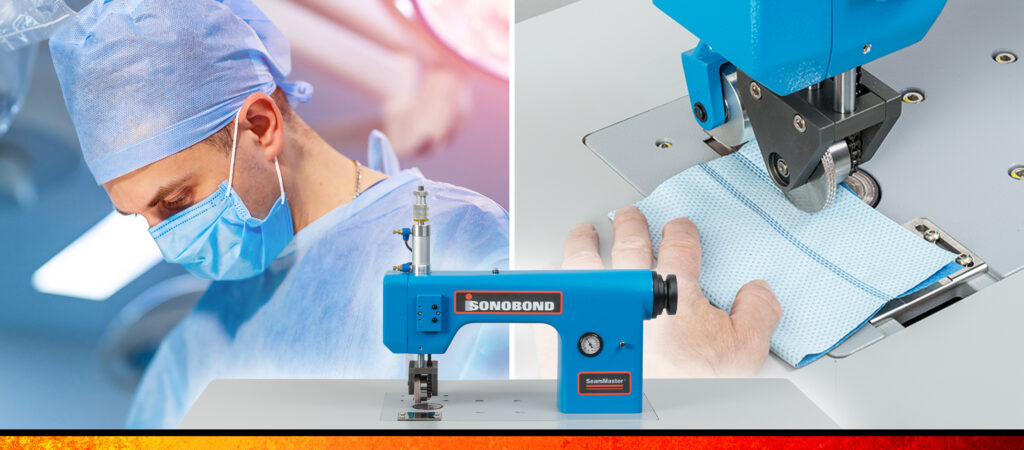
Disposable medical textiles often succeed or fail based on seam performance. Whether you’re producing face masks, isolation gowns, shoe covers or sterile instrument pouches, the joining method you choose affects barrier integrity and product consistency.
For manufacturers working with nonwoven fabrics, using an ultrasonic bonding system provides a proven way to create sealed edges and secure barrier seams. By using ultrasonic bonding technology, you avoid the common drawbacks of sewing, like stitch holes and fraying. You also dodge the gaps, cure time and consumables that come with adhesive bonding.
Read on to learn how ultrasonic bonding works, why it delivers superior seam performance in disposable medical textiles, and how it can help you increase output while supporting sterile production practices.
What is Ultrasonic Bonding of Nonwoven Fabrics?
Ultrasonic bonding of nonwoven fabrics uses high-frequency mechanical vibrations, applied under controlled pressure, to fuse layers of compatible materials at the seam. Instead of using a needle and thread or applying glue, an ultrasonic bonding system concentrates energy at the bond line to produce a strong, uniform seam. The process also seals the edge in the same pass.
When manufacturing medical textiles, you’re not just joining layers, you’re protecting performance. Seam integrity contributes to how well a product resists fluid entry, holds up during use and maintains consistent quality across high-volume runs.
Why Seams Fail in Medical Nonwovens
Most disposable medical textiles are assembled using one of three approaches: sewing, adhesive/thermal methods or ultrasonics. Sewing and adhesives can work, but each introduces seam-related risks that become more obvious when you scale production or tighten quality targets.
Sewing and Barrier Compromise
Traditional sewing creates a mechanically strong seam, but the needle also creates perforations via the stitch holes through the material stack. In barrier-critical items, those perforations can become pathways for fluids or particles. Sewing also introduces:
- Fraying or unraveling of cut edges
- Lint and thread handling considerations
- Downtime for rethreading, tension changes, needle maintenance and quality checks
Adhesives and Inconsistency
Adhesive joining can reduce perforations, but it often adds new variables, especially:
- Glue gaps or inconsistent coverage
- Cure time that can constrain line speed
- Consumables (adhesives, application equipment)
- Cleanliness concerns from adhesive strings, residue or overspray
Ultrasonic Bonding Advantages for Disposable Medical Textiles
Ultrasonic bonding is uniquely suited for nonwoven medical manufacturing because it directly addresses common seam failures, while also making it easier to run fast, repeatable production.
Barrier Seams Without Stitch Holes or Glue Gaps
Because an ultrasonic bonding system does not rely on a needle or adhesive bead, it creates seams that avoid two common barrier compromises: perforations through the seam line and dependence on uniform adhesive coverage.
Sealed Edges That Resist Fraying and Unraveling
Many disposable products fail at the edge before the body of the material fails. An ultrasonic bonding system seals edges in a controlled way, reducing fray or unravel tendencies and improving consistency from unit to unit.
Cleaner Production
Medical disposables manufacturers often aim for ultraclean processing to minimize lint, residue and foreign materials. Ultrasonic bonding supports this approach by eliminating thread, needles and glue in seam operations, thereby reducing sources of fibers and residues and simplifying what flows through the production line.
Faster Production and Higher Uptime
Ultrasonic systems can be run continuously in many applications. For high-volume disposables production, speed gains often compound with fewer stops for rethreading, fewer adhesive-related interruptions and fewer seam-related rejects.
Where to Use Ultrasonic Bonding in Medical Disposables Manufacturing
Many common disposable nonwoven medical products can be wholly or partially assembled using ultrasonic bonding systems. Typical examples include:
- Barrier seams for face masks
- Disposable medical gowns and isolation gowns
- Shoe covers and boot covers
- Lint-free wound dressings
- Pillow and mattress covers
- Pouches for sterilizing and storing medical instruments
Regulatory Context: Why Barrier Seams Matter
Different medical textile products are governed by various requirements, but the regulatory theme is common: manufacturers must demonstrate performance, consistency and, in many cases, barrier effectiveness.
Medical disposables manufacturers may encounter many standards including:
- Liquid Barrier Performance and Classification of Protective Apparel and Drapes in Health Care Facilities (ANSI/AAMI PB70)
- Standard Specification for Performance of Materials Used in Medical Face Masks (ASTM F2100):
Ultrasonic bonding doesn’t automatically make the process or product compliant. Testing and validation are still required. But an ultrasonic bonding system gives manufacturers a joining method that supports barrier seam goals by reducing stitch perforations and adhesive coverage variability at the seam line.
Sonobond SeamMaster® Ultrasonic Bonding System
For manufacturers evaluating equipment options, Sonobond’s SeamMaster® systems bond, seal and trim nonwovens and synthetics without thread, glue or other consumables to deliver fast, repeatable barrier seams.
Although similar in appearance and operation to traditional sewing machines, SeamMaster systems can bond up to four times faster than sewing and up to ten times faster than heat sealing or adhesive methods.
How to Evaluate Ultrasonic Bonding for Your Product Line
If you’re thinking about a transition from sewing or adhesives, consider:
- Material compatibility: Many nonwovens and synthetics bond well ultrasonically; blends may also be feasible depending on composition.
- Seam requirements: Where do you need sealed edges versus structural seams versus both?
- Throughput targets: What’s your desired units per minute, and what downtime are you trying to eliminate?
- Validation needs: What tests and standards apply and what seam samples are needed for qualification?
Sonobond provides no-charge, no-obligation sample bonding viability tests using your nonwoven or synthetic materials, so you can review sample assemblies and confirm results before purchasing.
Conclusion: Better Seams, Faster Production, Fewer Variables
For disposable medical textiles, the joining method isn’t just a production decision; it’s a product performance decision. Using an ultrasonic bonding system provides a way to create sealed edges and secure barrier seams without stitch holes or adhesive gaps, while improving line speed and reducing dependence on consumables.
If you manufacture disposable masks, gowns, medical covers, wound dressings or sterile storage pouches, ultrasonic bonding can help you raise seam quality and output.
Watch this short video to see the Sonobond SeamMaster in action.
To learn how ultrasonic bonding can improve your medical nonwovens manufacturing, contact us to discuss your specific application.